Testing For
Electrolysis
"Simply attach the
negative lead of the voltmeter to a good grounding point on the engine, and dip
the positive lead into the coolant..."
Can Electrolysis be measured? At the heart of any electrolysis
discussion is it's measurement. If it can be measured, it's presence
can be verified, which is extremely important when we are
classifying, treating, and removing the electrolysis.
To get started, lets take a couple quick
measurements with our Digital Volt Ohm Meter (DVOM)
|
|
|
|
|
|
|
|
 |
|
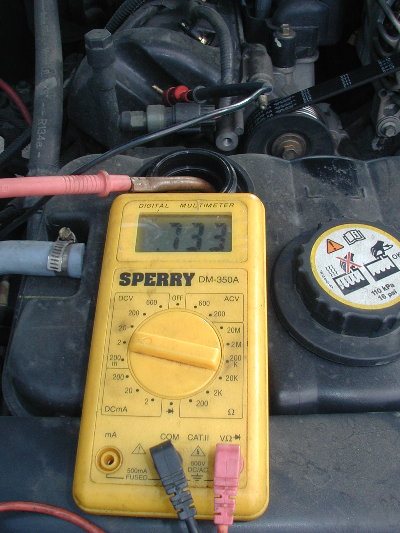
- Simply attach the negative lead from your DVOM to the engine
block or other known good grounding point. With the red
positive lead, dip it into the coolant. Ensure that your
DVOM is on the 2 volt scale.
- If you measured zero or near
zero, congratulations! You don't have electrolysis.
If you measured less than .1V, your cooling system should be
below the activity threshold, no action required.
However, if you measured .3V or above, then keep reading
because we have one more test to complete.
- Disconnect your battery terminal and re-measure as you
did in step number 1.
Find your result below.
|
| |
|
|
| |
|
|
Summary of Testing
| No Voltage Detected |
Take no Action |
|
|
| Voltage reads .3V or above even after battery cable(s) removed |
Type "B" electrolysis,
Go Here |
| |
|
| Voltage reads .3V or more, but
reads 0v when battery cable(s) removed |
Type "A" electrolysis,
Go Here |